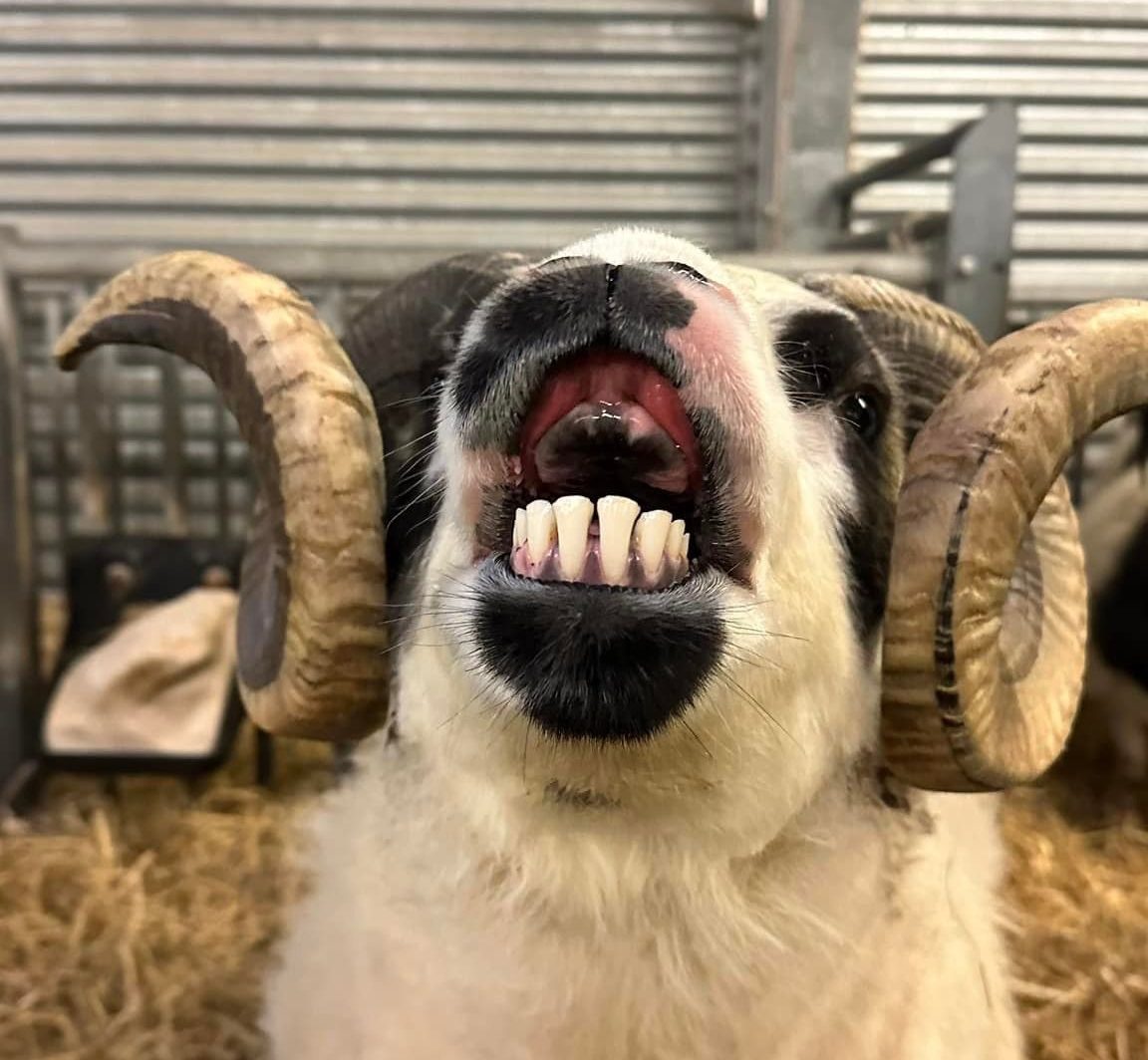
Most ruminants do not have upper front teeth and one of those animals is Icelandic sheep as we can see in the image taken of Jökull our ram.
But what is rumination? It is a symbiotic relationship between mammals and microbes. Ruminants are herbivores that have a stomach that has four-chambers which are called the rumen, the reticulum, the omasum and the abomasum. The grass goes mostly unchewed into the rumen where it is stored, mixes with saliva and fermentation occurs. Ruminants produce a large amount of saliva, and it is thought that cows produce around 100 liters daily while sheep produce around 10 liters daily. However, humans only produce around 1 and a half liters daily. Many microbes can be found in the first chamber of the stomach. Studies have shown that in 1 ml of contents from the rumen, 10-50 billion microbes can be found along with 1 million protozoa and fungi. Microbes play a role in disassembling cellulose and produce volatile fatty acids which are the animal’s main energy source. Since the process in the rumen is anaerobic, a large amount of carbon dioxide (CO2) and methane (CH4) that the animals need to burp out.
After the microbes have done their job in the rumen, the animal regurgitates the food back into its mouth in small portions, chews it thoroughly and swallows it again. This first part of their digestion is called rumination. When we observe animals as they ruminate, they often relax as they lie on the ground in a field or in their pen and chew their cud thoroughly like people chewing a piece of gum.
When the animals have chewed their cud well enough, the feed will travel to the next chambers, where the food will be digested and energy in the form of water and volatile fatty acids will be absorbed. Next, the food travels to the small intestine where amino acids and other nutrients are absorbed. The first three stomach chambers are often called “formagi” in Icelandic or the “pre-stomach” while the abomasum is referred to as the actual stomach.
Animals that do not ruminate cannot use cellulose as an energy source and therefore need a more diverse diet. Since ruminants have a symbiotic relationship with microbes, they can live on a nutritiously low diet because the microbes change the cellulose into energy and the animal in turn gets organic chemicals (Nitrogen, Sulphur and Phosphorous) from the microbial community. For the microbes, the stable and safe environment is what matters most for them so that they can procreate.
There are around 150 known species of ruminants. Amongst them are cows, goats, sheep, reindeer, giraffes, deer, camels, lamas, antelopes and koalas.
The information above is retrieved from Vísindavefurinn, amongst other websites, where answers to all kinds of questions can be found.